



Picking the right transformer for an AI data center isn't just a line item on a spec sheet — it directly affects how stable your power supply is and how much you'll pay in electricity bills for years to come. A large AI server can draw three to five times more power than a standard server, and once you stack thousands or tens of thousands of these machines together, the strain on the power system multiplies fast. The transformer sits at the heart of it all: it takes the high-voltage power coming in from the grid and steps it down to a voltage your equipment can actually use. Get it right, and you get stable power and predictable costs. Get it wrong, and you're looking at inflated electricity bills at best, and outage risk at worst.
This article walks through how to choose a transformer, compares dry-type and oil-immersed designs, and takes a closer look at solid-state transformers (SST) — a technology that's been gaining real momentum over the past couple of years.
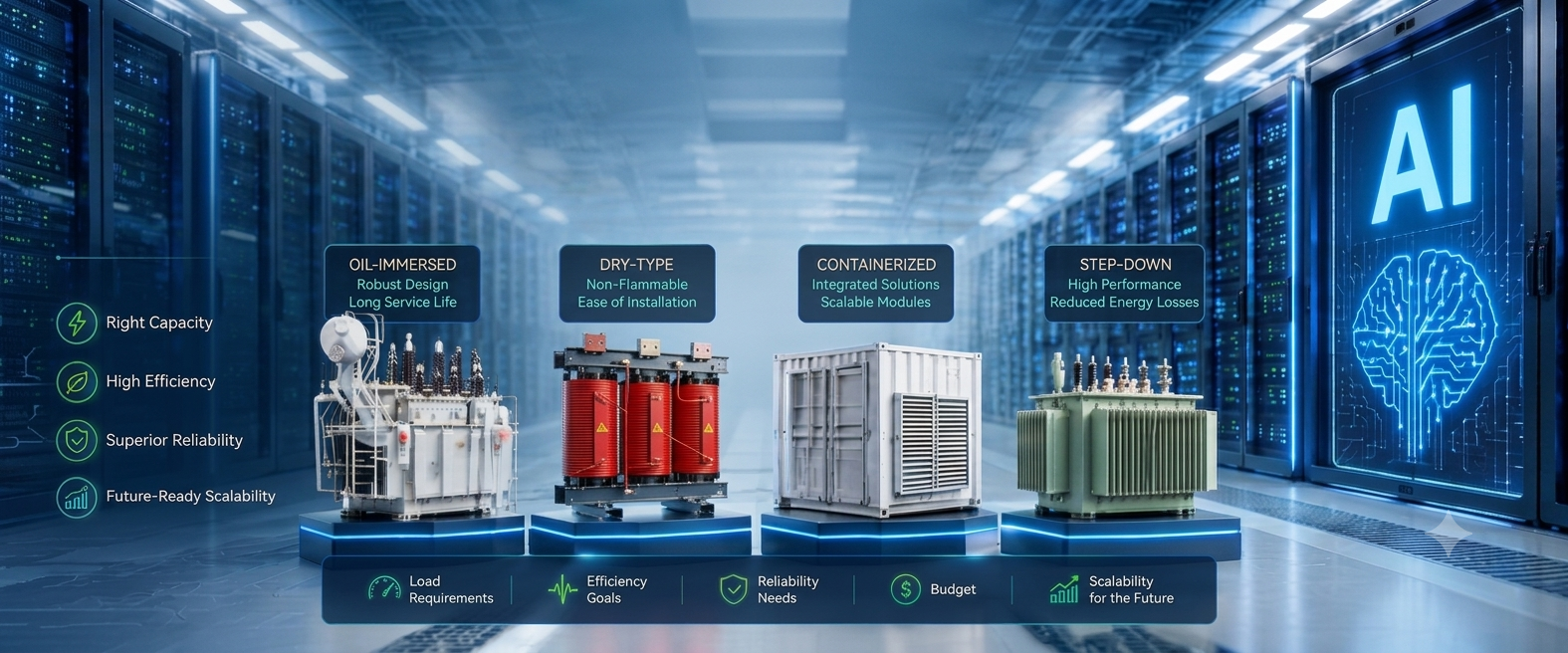
1. What New Demands Does AI Bring to Transformer Selection?
A traditional data center usually runs at 4 to 6 kW per rack. AI data centers (often called AIDCs in the industry) have already pushed past that, running at 20 to 40 kW per rack today, with projections heading toward 40 to 120 kW or higher in the near future. Industry researchers estimate the data center transformer market will reach RMB 10.07 billion, 15.44 billion, and 20.85 billion between 2025 and 2027. That kind of growth reflects some very real engineering challenges.
Broadly speaking, what AI data centers need from a transformer comes down to three things: high reliability, low losses, and smart monitoring.
High Reliability: How Strict Are the Standards?
A data center runs around the clock, so a transformer failure means computing capacity goes down with it. The industry standard is typically 99.999% availability — in other words, no more than about five minutes of downtime a year. That's a high bar, and it puts real pressure on both manufacturing quality and ongoing maintenance.
Low Losses: Efficiency Ratings Hit the Electricity Bill Directly
A transformer consumes power just by running, and that loss goes straight into your operating costs. China's newest efficiency standard for power transformers, GB 20052-2024, took effect in February 2025 and sorts transformers into three efficiency tiers, with Tier 1 being the highest. Most data center projects now aim for Tier 1, and over the long run, that choice can add up to substantial electricity savings.
Smart Monitoring: From "Install and Forget" to Real-Time Alerts
The old approach — install a transformer and leave it alone until something breaks — doesn't cut it anymore. Transformers in AI data centers now come fitted with sensors that track oil temperature, load, and other parameters in real time, flagging problems before they turn into failures rather than after.
2. Traditional Transformers: Dry-Type or Oil-Immersed?
Most data centers today still rely on traditional transformers, which fall into two main categories: dry-type and oil-immersed.
Dry-Type vs. Oil-Immersed
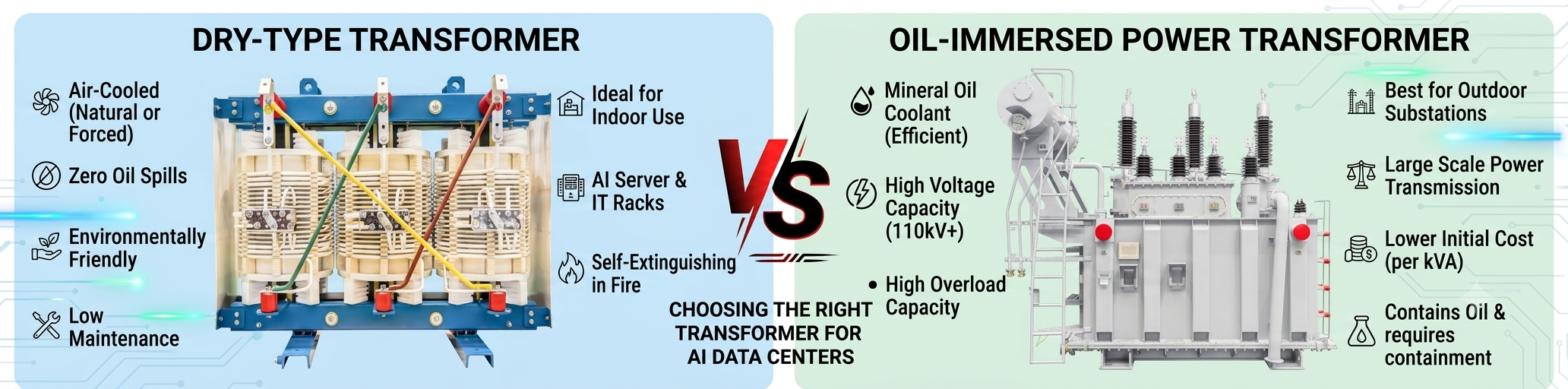
A dry-type transformer keeps its core and windings out of insulating oil, relying instead on air or epoxy resin for insulation. Its main advantage is safety — with no oil, there's no risk of leaks, which makes it a natural fit for indoor installations, especially in a data center where equipment is dense and expensive. The trade-off is that it takes up more space and costs more for the same capacity. Even so, dry-type transformers are the default choice for data centers.
Oil-immersed transformers submerge the core and windings in insulating oil, which gives them better heat dissipation, a smaller footprint, and a lower price tag. They work well outdoors or in a dedicated transformer room. The downside is the risk of oil leaks and fire, which limits how freely they can be installed indoors.
How Do You Calculate Transformer Capacity?
Transformer capacity is measured in kVA (kilovolt-amperes), not kW (kilowatts). Converting between the two depends on the power factor, which data centers usually estimate at around 0.95. In practical terms: if your IT load totals 1,000 kW, once you factor in power factor and redundancy, you'll typically need a transformer rated around 1,250 kVA. As a general rule, keep the load factor under 80% and leave 15% to 20% of headroom for future expansion.
Can It Handle Overload?
AI workloads aren't as steady as traditional ones — the moment a training job kicks off, power draw can spike almost instantly. A transformer built for a data center should be able to handle short-term overloads, and some models can sustain 150% load for a full hour, or handle brief spikes up to 200%.
What About Harmonics?
Server power supplies, UPS units, and similar equipment generate a lot of harmonic current, which causes extra heating in the transformer and shortens its lifespan. When selecting a transformer, pay attention to winding design and harmonic resistance, and pair it with filtering equipment where needed.
It's also worth noting that China's data center design code, GB 50174-2017, requires a dedicated distribution transformer for any data center with a sizable power load, so it doesn't have to share capacity with other loads and risk interference.
3. Solid-State Transformers (SST): An Emerging Alternative
Everything above applies to traditional transformers. But over the past few years, a new technology called the solid-state transformer (SST) has been making its way into the conversation.
How Is an SST Different from a Traditional Transformer?
A traditional transformer works on electromagnetic induction — an iron core wrapped in copper coils, running at a fixed 50Hz. An SST instead uses power electronics, mainly wide-bandgap semiconductors like silicon carbide (SiC), to step voltage up or down, and it operates at frequencies far higher than standard grid frequency. The payoff is a much smaller footprint and higher efficiency.
Here's a real example: In July 2026, Sungrow launched EnerNeo, a solid-state transformer built for AI data centers. The whole unit measures just 6 meters long, 1.6 meters wide, and 2.4 meters tall, with a power density of 312 kW per square meter — about 50% less floor space than a conventional setup. It can convert 10kV to 13.8kV medium-voltage AC directly into 800V DC output, cutting out two to three redundant conversion stages found in traditional power chains, and it runs at a system efficiency of 98.5%.
Why Do AI Data Centers Need SST?
The core issue is space and efficiency. NVIDIA's technical white paper has already named the solid-state transformer as the ultimate power solution for next-generation AI infrastructure. As AI rack power climbs to 300 kW, 600 kW, or even 1 MW, the limits of traditional power delivery start to show — one data point suggests that at 1 MW per rack, the power distribution system alone can take up ten times more floor space than the IT racks themselves. In a data center where every square meter counts, that ratio simply isn't sustainable.
From a technology standpoint, 800V high-voltage DC power is becoming the leading direction for AI data centers. The traditional setup runs through several conversion stages — medium-voltage transformer, then low-voltage AC distribution, then UPS, then server power supply — and each stage loses some energy along the way. SST takes a more direct route: medium-voltage AC straight to 800V DC, in one step, with a shorter path and fewer losses.
What Real-World Challenges Does SST Still Face?
• Cost: SST is still considerably more expensive than traditional transformers.
• Maturity: the technology has been in development for years, but large-scale commercial deployment isn't expected until around 2028.
• Lack of standardization: major cloud providers — Google, Microsoft, AWS, Alibaba, Tencent — are each pursuing their own technical approach, and the industry has yet to settle on a common standard.
It's also worth keeping an eye on how the global SST market is shaping up. Established power equipment giants like ABB, Hitachi Energy, Siemens, and Eaton are active internationally, while domestic players such as CEEG, China XD Electric, Jinpan Technology, and Sungrow are moving quickly to build out their positions. China's Ministry of Industry and Information Technology, along with three other government bodies, has already added large-capacity solid-state transformers to its national priority list under the Implementation Plan for High-Quality Development of Energy-Efficient Equipment (2026–2028).
4. So How Should You Actually Choose? A Few Practical Pointers
Taking all of this together, here are the main factors worth weighing when choosing a transformer for an AI data center.
Consider Your Project Size and Power Density
For a typical AI computing center running at 20-40 kW per rack, a traditional dry-type transformer paired with an efficient UPS setup is still perfectly adequate — the technology is mature and the cost is manageable. But for hyperscale clusters pushing past 100 kW per rack, the advantages of SST start to become much harder to ignore.
Consider Your Availability Requirements
Financial institutions and government data centers demand extremely high availability, and traditional systems have years of proven reliability behind them. SST's theoretical availability looks strong on paper too, but large-scale commercial validation is still a work in progress.
Consider Efficiency and Operating Costs
The purchase price of a transformer is a one-time expense, but the energy it loses while running adds up as a long-term bill. Moving up one efficiency tier can translate into meaningful savings over the years. With GB 20052-2024 now in effect in China, it's worth prioritizing Tier 1-rated equipment. SST offers higher efficiency, but the upfront investment is significant, so it's worth running the numbers on total lifecycle cost before committing.
Consider Room to Grow
AI computing demand tends to grow faster than anyone expects, and building out a data center in phases is the norm rather than the exception. Reserved capacity, modular design, and the ability to expand smoothly down the road are all things worth factoring into your decision from the start.
Consider the Supplier's Engineering Capability
A transformer isn't something you can just buy and plug in — it involves coordinating with the grid, matching downstream distribution equipment, and handling installation and commissioning. Choosing a supplier with real, hands-on experience delivering data center projects matters far more than comparing spec sheets. If you'd like help figuring out the right sizing for your project, reach out to our CEEG engineering team for a free assessment.
5. Looking Ahead
The power demands of AI data centers keep climbing. The International Energy Agency projects that global data center electricity consumption will pass one trillion kilowatt-hours in 2026. The transformer, once a piece of background infrastructure, is turning into a key factor in how competitive a computing facility can be.
Traditional transformers will remain the workhorse for the next several years, but the tipping point for solid-state transformer commercialization is approaching. If you're planning an AI data center project, it's worth tracking SST developments and staying in touch with leading suppliers now, rather than waiting until the technology is fully mature. Power system planning takes a long time, and discovering a supply gap only after your racks are already in place is a costly mistake to make.
Frequently Asked Questions
1. How is a transformer for an AI data center different from one used in a traditional data center?
Three main differences: it needs to meet a higher reliability bar (typically 99.999% availability), a higher efficiency rating (usually Tier 1), and it needs smart monitoring plus short-term overload capacity to handle the sharp swings that come with AI training workloads.
2. Should I choose a dry-type or an oil-immersed transformer?
For indoor installations where safety is the priority, dry-type is the better choice and the default option for most data centers. If you're installing outdoors or have a dedicated transformer room and cost or footprint matters more, an oil-immersed unit is worth considering.
3. How do I calculate the transformer capacity I need?
Start with your total IT load in kW, convert it to kVA using a power factor of around 0.95, then add 15-20% of headroom for future growth. Keep the load factor under 80% as a general rule.
4. What exactly is a solid-state transformer (SST)?
It's a new type of transformer that uses power electronics — mainly silicon carbide components — instead of traditional electromagnetic induction. It can convert medium-voltage AC directly into 800V DC, delivering higher efficiency and a smaller footprint, and it's an emerging trend in AI data center power design.
5. Is SST ready for large-scale deployment yet?
SST has already been deployed in a handful of flagship projects, but cost and the lack of unified industry standards mean large-scale commercialization isn't expected until around 2028.
6. What's the most commonly overlooked factor when selecting a data center transformer?
Many people focus only on the spec sheet and overlook a supplier's engineering delivery capability. Transformer installation involves coordinating with the grid, matching distribution equipment, and commissioning — so choosing a supplier with real data center delivery experience matters more than it might seem.
Need a Sizing Plan Tailored to Your Project?
Every AI data center project has its own power density, availability requirements, and budget, so a spec sheet alone can't give you the final answer. Reach out to our CEEG team for a free transformer sizing recommendation and quote:
Email: info@ceegenergy.com
Mobile: +86 18061639839